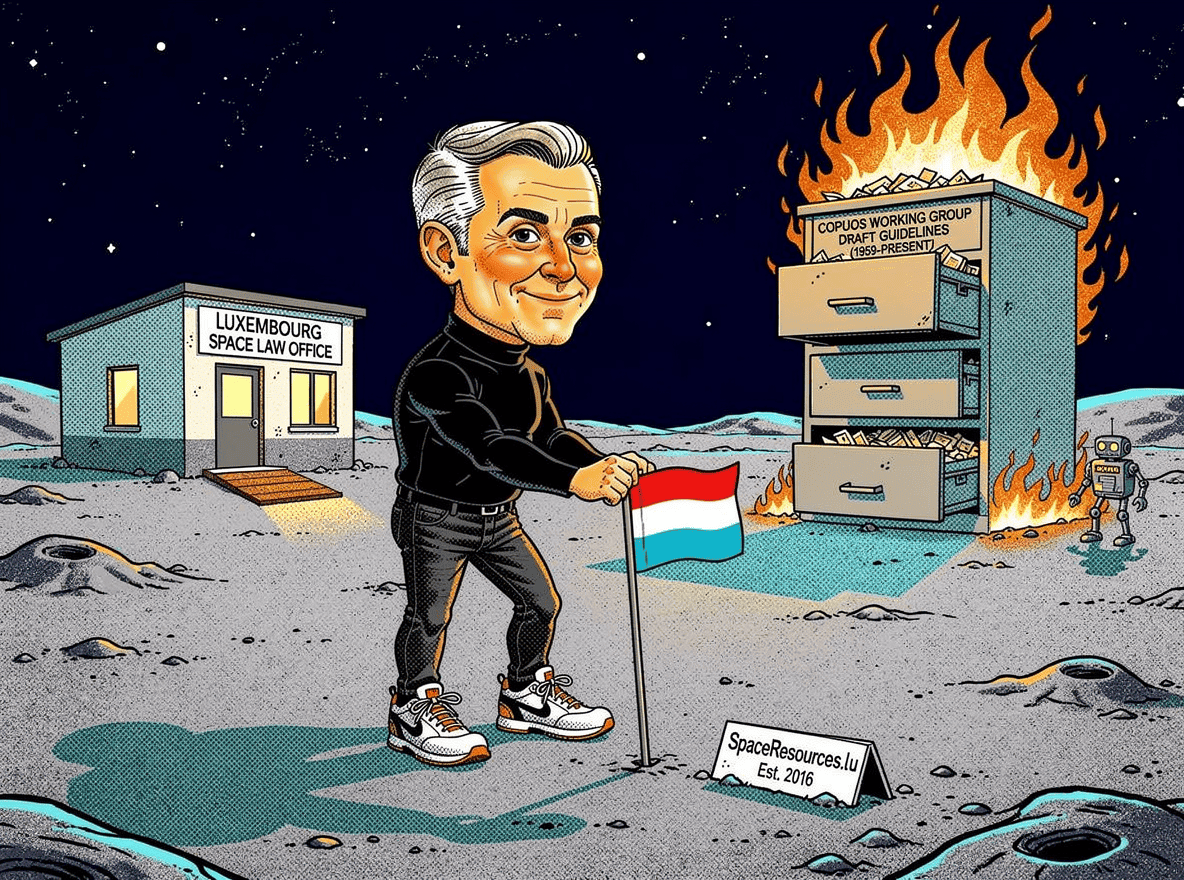
Luxembourg has a population of roughly 660,000 people. It has no launch facilities. It has no space program in the traditional sense. It doesn't have a cosmonaut. What it does have, since 2017, is the clearest domestic law in Europe specifying that companies extracting resources from celestial bodies own those resources outright, no sovereignty claim required.
The law, formally the Law of 20 July 2017 on the Exploration and Use of Space Resources, followed the US Commercial Space Launch Competitiveness Act of 2015 by two years. Luxembourg did not invent the approach; it copied and refined it. But the country's SpaceResources.lu initiative, launched in 2016, positioned the Grand Duchy as a destination for space resource companies wanting a permissive regulatory environment, access to EU markets, and the legitimacy of a European Union member state's legal framework behind their operations. ispace Europe, the European arm of the Japanese lunar lander company, incorporated in Luxembourg. Others followed.
This isn't Luxembourg's first rodeo with regulatory positioning. The country built much of its modern wealth by becoming a favorable jurisdiction for financial services: investment funds, bond issuance, broadcasting licenses. The formula is consistent: identify an emerging sector before the big countries write the rules, write your own rules first, and let the companies come to you. The Delaware analogy is obvious and not entirely unfair.
The gap between Luxembourg's legal clarity and the international framework's progress is instructive. The UN Committee on the Peaceful Uses of Outer Space, COPUOS, has existed since 1959. It operates by consensus among its 104 member states. Its working group on space resources has been deliberating for years and has produced guidelines rather than binding law. The 1967 Outer Space Treaty prohibits national appropriation of celestial bodies but is silent on resource extraction by private entities, a gap that was not particularly relevant in 1967 and is quite relevant now.
The Artemis Accords, which by early 2026 have been signed by 61 nations including Luxembourg, establish bilateral norms around transparency, interoperability, and the concept of safety zones around operations. They are not a treaty. They are not binding in the way a treaty is binding. They are a statement of intent by the parties that happen to have the resources and technology to act on them.
The result is a patchwork: clear domestic law in a handful of countries, an evolving set of soft-law commitments among the technologically capable, and a UN process that moves at the pace institutional consensus requires. The Moon does not care about any of this. The deposits are simply there, waiting for whoever arrives with the right equipment and the right legal domicile.
AI Beat Reporter tracks the machine. Tries to keep up.